A company with an ACN but no ABN: what it means and when it is a red flag
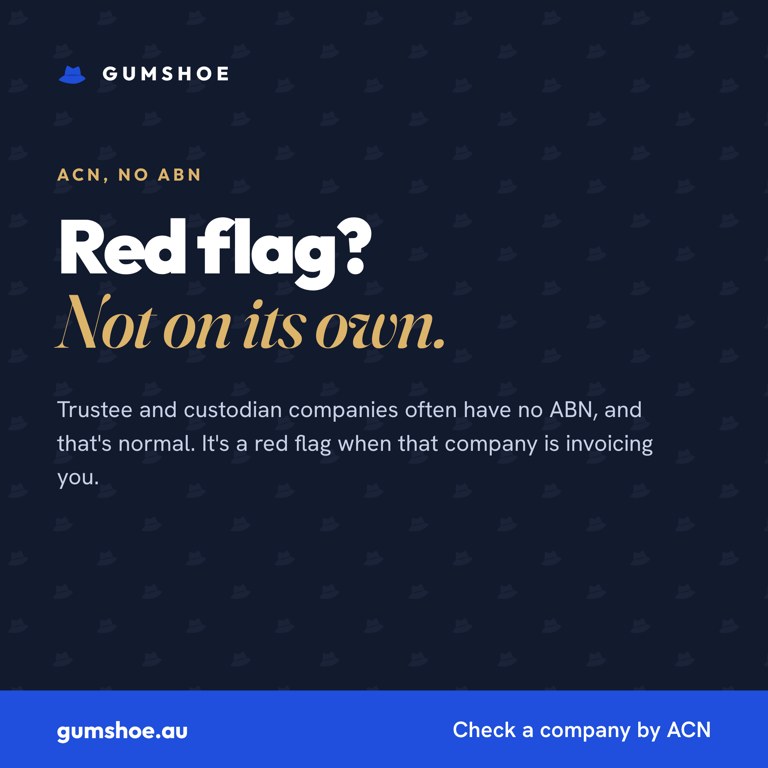
A company with an ACN but no ABN is not a red flag on its own. Trustee and custodian companies often have none. Here is when it matters, and what to do.
Every Australian company has an ACN, the nine-digit number ASIC gives it when it's registered. Not every company has an ABN. When Gumshoe finds a company on the ASIC register with no ABN on the Australian Business Register, it shows a No ABN result and lets you run a company check by ACN, with a dated record you can keep. Here's what that result means and what to do about it.
A company doesn't have to have an ABN
The ABN is for entities carrying on an enterprise. A company registered under the Corporations Act is entitled to an ABN, but it isn't obliged to hold one. Plenty of legitimate companies never apply.
Common, usually harmless reasons
- Trustee or custodian companies. A company that only acts as trustee of a trust, or as the custodian holding an asset on bare trust, often has no ABN of its own. A common example is the custodian company that holds a property for a self-managed super fund's borrowing arrangement: the super fund holds the ABN, not the custodian. Names ending in Custodian, Nominees or Trustee are a strong hint.
- Holding and dormant companies. A company that just owns shares in other companies, or isn't trading yet, may not need one.
- Newly registered companies. A company can be registered with ASIC before its ABN application is finalised.
The ABN may also sit with a related entity. For a trustee company, search for the trust (it often appears on the ABR as "The Trustee for …").
When it is a red flag
No ABN on its own isn't a warning sign. These combinations are:

- It's invoicing you, or asking to be paid. A business supplying goods or services in the course of an enterprise should quote an ABN. If it doesn't, the ATO generally requires you to withhold the top rate of tax (47%) from payments over $75, excluding GST, unless an exemption applies and you keep a record of why.
- It had an ABN that's now cancelled. A cancelled ABN can't be validly quoted on an invoice.
- The invoice quotes an ABN that belongs to someone else. Check that the ABN's legal name matches the company you're dealing with.
- It's brand new and pushing for urgent payment, especially to a new bank account.
- It's in external administration, has a strike-off action, or is deregistered.
Is it a sign the company is overseas?
Not usually. A foreign company that registers to do business in Australia gets an ARBN, not an ACN. A company with an ACN and no ABN is an Australian company that simply hasn't registered for one.
What to do
- If it's a supplier: ask for its ABN before you pay. Don't pay in full on the promise that one is coming: applying for an ABN isn't the same as quoting one. If it can't quote one, take advice on withholding.
- If it's a client or a related party, such as a trustee or custodian company, check the trust or fund that holds the ABN as well.
- Keep the record. Gumshoe's company check by ACN saves a dated record of what ASIC and the live Australian Business Register showed when you checked, with a permanent link you can file.
What Gumshoe checks without an ABN
The company check by ACN covers ASIC registration, status and age, and a live check of the Australian Business Register for a linked ABN. It also checks ASIC insolvency notices, the banned and disqualified register, credit licences and the DFAT sanctions list. The full Gumshoe check is built on the ABN record, so it isn't available until the company has one.
Business information only, not tax, legal or financial advice. Withholding rules have exceptions; check the ATO's guidance on withholding if an ABN isn't provided, or ask your accountant.